
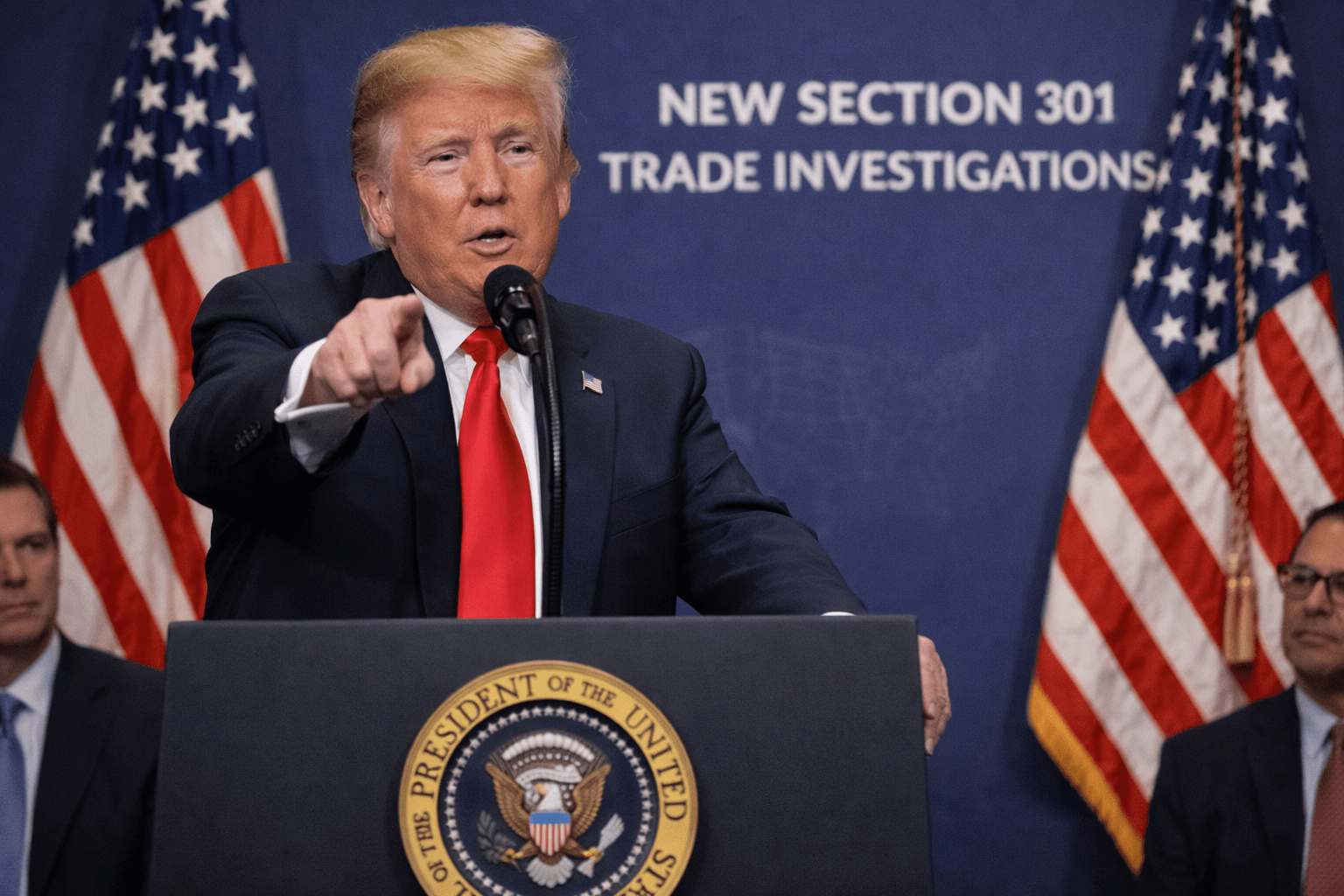
Less than a month after the US Supreme Court knocked down a key part of his earlier tariff strategy, President Donald Trump is back with a new trade agenda.
The Trump-led US administration has opened fresh Section 301 investigations into the practices of 16 major trading partners.
The development matters for US businesess and consumers as Section 301 is not just a policy review tool, but provides the US Trade Representative (USTR) with formal powers to impose tariffs or other trade restrictions if it finds foreign practices are unfair or discriminatory.
Why Section 301 matters now?
The immediate backdrop is legal as much as economic.
The White House is looking for a sturdier legal route to reimpose the tariffs on various nations after facing the Supreme Court setback last month.
Section 301 comes from the Trade Act of 1974, and it empowers the USTR to investigate foreign acts, policies, and practices that burden US commerce.
If the investigations find credible trade threats and issues from other nations, the administration can respond with tariffs or other countermeasures.
That makes it slower than an emergency tariff order, but also more structured and potentially harder to overturn because it runs through an established investigative process.
This round of investigations is aimed at what the administration calls “structural excess capacity and production in manufacturing sectors.”
The phrase points to long-running US complaints that foreign producers are flooding global markets with subsidized or surplus goods.
The cases are broad in scope.
The 16 economies under investigation include China, the European Union, India, Japan, South Korea and Mexico, along with Taiwan, Vietnam, Thailand, Malaysia, Cambodia, Singapore, Indonesia, Bangladesh, Switzerland, and Norway.
What could it mean for tariffs and trade?
For now, these investigations don’t necessarily mean that tariffs will be imposed.
The next steps involve public comments, hearings, and an interagency review before the administration decides whether specific countries or sectors deserve penalties.
Moreover, the political message is hard to miss.
Trump used Section 301 during his first term to support tariffs on many Chinese imports, and the law is still regarded as one of Washington’s most robust trade tools after surviving earlier legal challenges.
In practical terms, the administration is signaling that even after a court setback, it is not backing away from tariffs as a core industrial and trade weapon.
The developments come at the worst time possible, as the US-Israel-Iran war is already creating a ton of uncertainty in the markets.
Exporters, importers, and manufacturers now have to weigh not only whether new tariffs will be imposed, but also which products, countries, and supply chains could be pulled into the fight.
Section 301 turns a court defeat for one tariff strategy into the opening move of another.
The post Trump’s trade weapon returns: what Section 301 investigations mean appeared first on Invezz